KOR’K Sensor
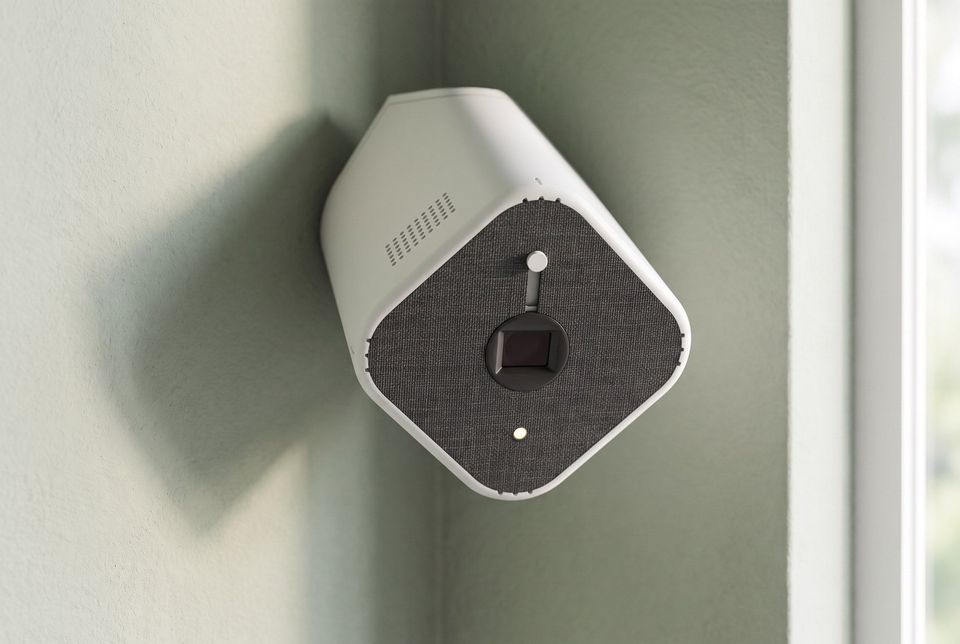
A prototype: a 12.4 cm diamond-shaped device that sits in the corner of a room. It is not a product for sale.
V1 prototype · EELISA Prototype Contest, JOSEPHS, Nuremberg, 8 to 11 December 2026
AI-generated image (Artlist, Nano Banana Pro) based on the exact 3D render of the V1 prototype. It is not a photograph of the prototype.
Capturing everyday life, without taking out your phone.
KOR’K Sensor is a prototype, shown at the EELISA Prototype Contest (JOSEPHS, Nuremberg, 8 to 11 December 2026). It is not a product for sale: it has no price and no release date.
01 · The idea
Why a device
Filming means remembering to take out your phone, at the right moment. The most telling moments often happen when nobody is filming. The Sensor is a small device that sits in the corner of a room and captures these moments for the parent.
It was KOR’K’s starting idea. The app came out first, because an object is expensive and risky: manufacturing, certification, production runs.
02 · The prototype
An object the size of a hand
The V1 as it goes to print: a diamond 12.4 cm along the walls, which fits into a corner.
- 12.4 cm
- along each wall
- 11.8 cm
- tall
- 9.1 cm
- wide, for the diamond with rounded edges
- 20°
- of camera tilt below the horizontal
Source: V1 technical drawings (9 November 2026).
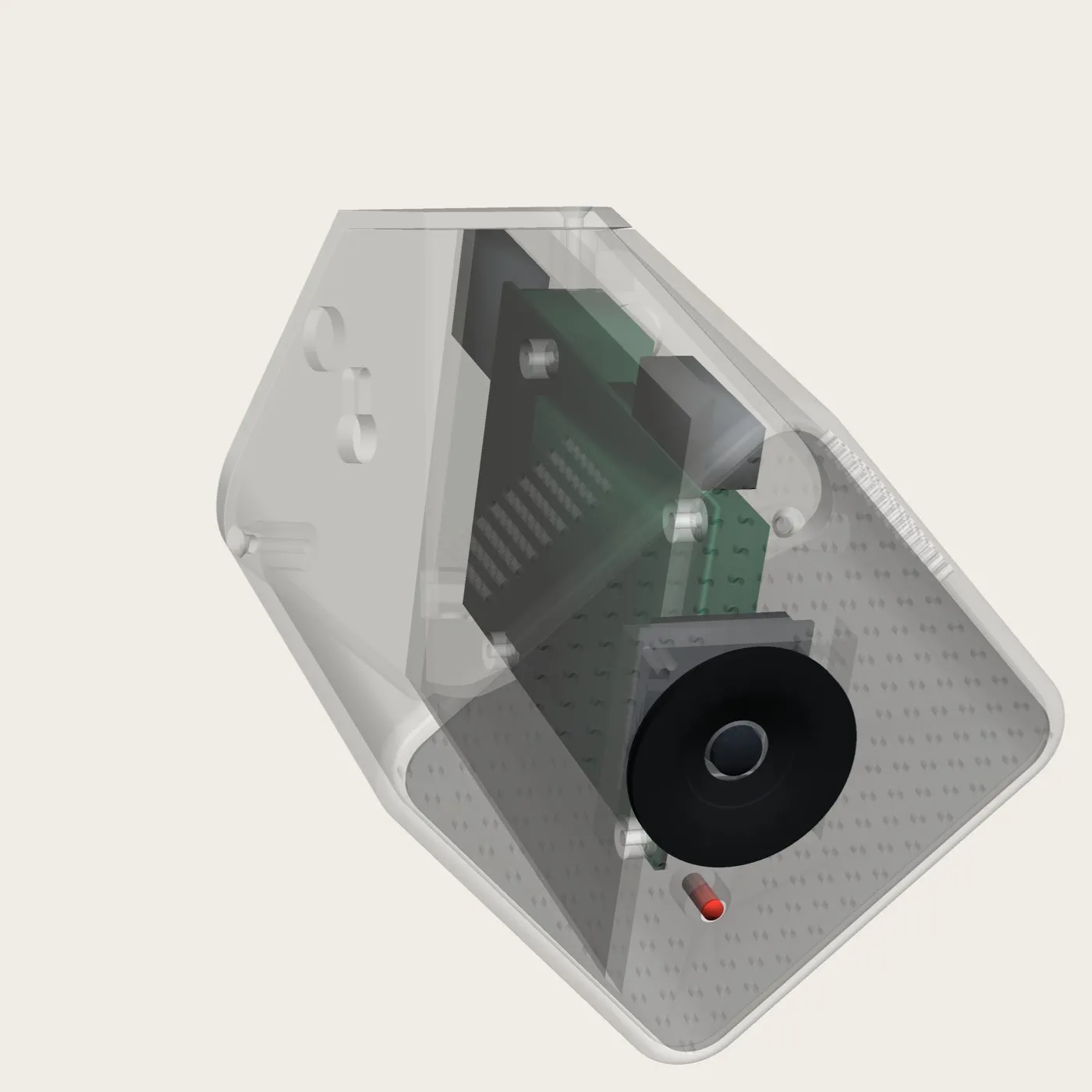
The device, piece by piece
Turn it, pull the parts apart, close the shutter, switch on the indicator light.
The 3D view loads as you approach this section.
What is inside
- Raspberry Pi 5, 4 GB
- The device’s computer. It films, and keeps the clip in RAM.
- Camera Module 3 Wide
- A 12 MP wide-angle camera: 120° diagonally.
- An indicator light and a microphone
- The light shows when the camera is filming; the microphone picks up sound.
- The power supply
- An official 27 W power supply, outside the housing: no mains voltage inside.
For Nuremberg, a translucent front
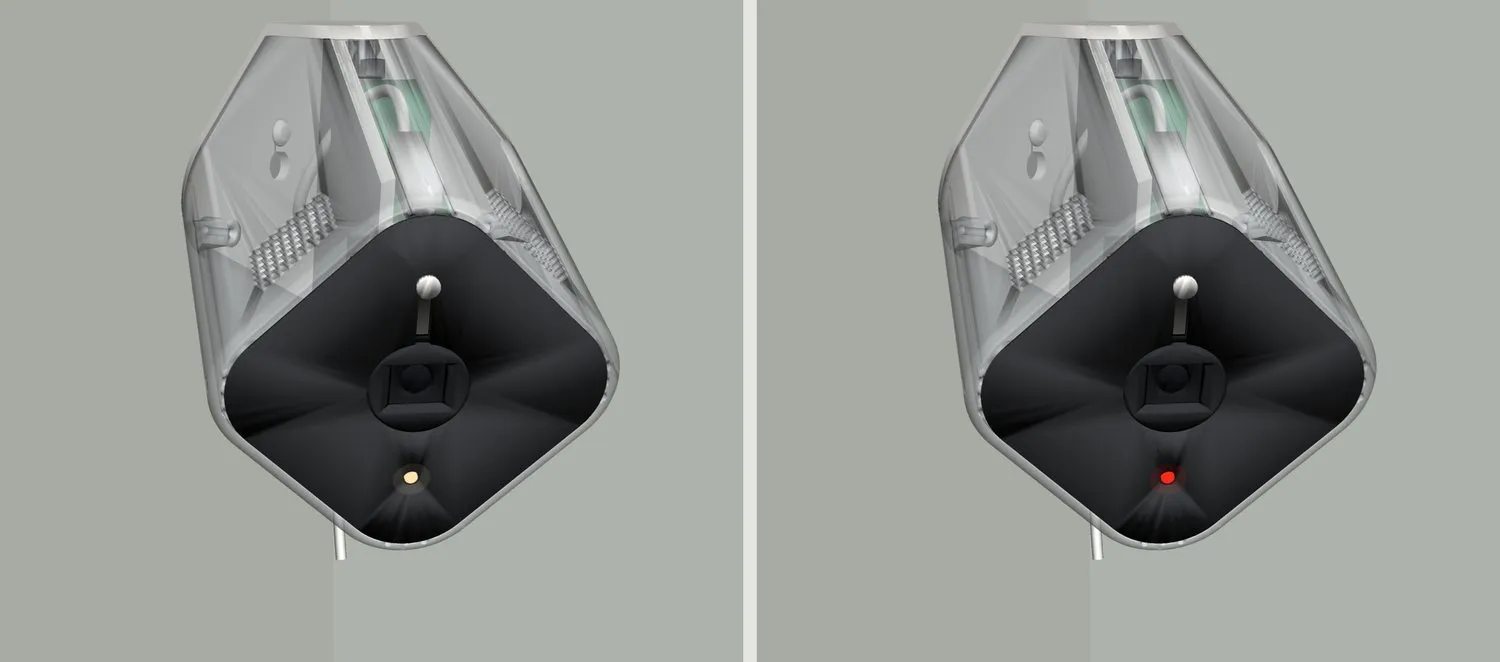
The device shown in Nuremberg has a translucent front: you can see the electronics, and understand that nothing is hidden. A black block surrounds the camera and the indicator light, so that the room’s light does not fog the image.
03 · Engineering
Where to put the device?
Every choice behind the device rests on a calculation or a test. The first one: at what height to place it to see a playing child’s face as often as possible, while staying out of reach.
13.4%
of the time, the child’s face is usable with the device at 1.6 m and tilted by 20°. On the ceiling, at 2.3 m, it drops to 7.0%.
Share of time the child’s face is usable, by height of the device
Device in a corner, tilted by 20°. Simulation of a 3.5 × 3.5 m bedroom.
See the data
| Height | Usable face | Floor covered (seated child) |
|---|---|---|
| 1.0 m | 19.4% | 99.9% |
| 1.1 m | 18.4% | 99.7% |
| 1.2 m | 17.3% | 99.3% |
| 1.3 m | 16.3% | 98.9% |
| 1.4 m | 15.3% | 98.3% |
| 1.5 m | 14.3% | 97.7% |
| 1.6 m, chosen | 13.4% | 96.9% |
| 1.7 m | 12.5% | 96.0% |
| 1.8 m | 11.5% | 95.0% |
| 1.9 m | 10.5% | 93.9% |
| 2.0 m | 9.6% | 92.7% |
| 2.1 m | 8.7% | 89.9% |
| 2.2 m | 7.8% | 88.3% |
| 2.3 m | 7.0% | 86.7% |
| 2.4 m | 6.2% | 84.9% |
- The figure assumes cropping on the child. Without it, it drops to less than 1%.
- In the V1, the filmed area is fixed. The device always crops the same square of floor: a child who leaves it is no longer seen.
- A simplified model, not a measurement: no furniture, no body hiding the face, a single typical bedroom.
The other studies (pixels, exposure, analysis tests) are in the prototype area. Prototype area, access code required →
04 · Trust
A camera in a room has to earn trust.
Who does what
The device
Films a clip, and keeps it in RAM.
The iPhone
Collects the clip over the same Wi-Fi network. The KOR’K Scan app sends it, like any other video.
The cloud
The KOR’K Scan server, then the Google Gemini API, analyse the video and produce the report.
Neither the device nor the iPhone analyses anything. The rest of the journey is the same as for KOR’K Scan. The journey of your videos
An indicator light, visible from the whole room
White: the preview, nothing is recorded. Red: recording. It stays on as long as the camera is filming.
A shutter, closed by hand
A small button slides a white disc in front of the lens. When it is closed, nothing gets through, whatever the state of the software.
What it does today
- It films short clips from the corner of a room.
- The parent’s iPhone collects these clips.
- The analysis then takes place in the cloud, just like for a video filmed on a phone.
What it does not do
- It analyses nothing: AI inside the device remains a goal.
- It does not follow the child.
- It does not record continuously.
It is a demonstration prototype: it must never be left unattended with a child.
05 · Nuremberg
Nuremberg, 8 to 11 December 2026
The prototype is shown at the 5th EELISA Prototype Contest, at JOSEPHS, the FAU’s open innovation lab in Nuremberg. KOR’K was selected by PSL-Pépite, with KOR’K Scan and the Sensor.
8 to 10 December
Three days of method
Innovating from customers, placing your prototype in its market, gathering their feedback.
11 December
Public tests and final
Invited visitors and experts from JOSEPHS, NIM and FAU try the prototypes, give their opinion and vote.
What Nuremberg tests
A working model, to test three things: the shape of the device, its place in a room, and the trust it inspires.
It does not yet prove that the device is useful to a family: that will take trials with real families.
The stand rules
A marked area on the floor
A sign in French, English and German says so at the entrance: “Here, and only here, the KOR’K Sensor may film you.”
Nothing without explicit consent
Recording only starts after an “I agree” on the iPhone, or a spoken agreement.
No child without a parent
And the device is never above a child: it is fixed at the top of a corner of panels, with the lens at 1.6 m.
Clips deleted
After the demonstration, the clips are deleted. None is sent for analysis without a second consent.
Demonstration reports
The app’s report is shown on videos prepared in advance, never on the visitors’ ones.
06 · Next
After Nuremberg
The prototype is only one step. The next versions of the device:
- A V2, corrected after image tests with the real device.
- A custom circuit board, to get back to about 10 cm along the walls.
- Longer term, the goal is analysis inside the device, so that no video leaves the home.
The full studies, the design journal and the drawings: prototype area, access code required →Today, KOR’K is KOR’K Scan, on iPhone →